If you’ve ever found yourself in the middle of a grocery store aisle or a quiet living room, watching your child experience a massive emotional "meltdown" while you desperately try to explain why they can’t have the blue cup, you know one thing for certain: logic does not work in the middle of the dysregulated moment.
As parents of children with sensory needs, ADHD, or autism, we often feel like we’re failing when our "reasonable" explanations fail to support our child. But here is the secret I want to share with you today: it’s not that your child isn’t listening; it’s that their brain literally cannot hear you yet.
We want to help you understand the "why" behind behavior is the first step toward better a more peaceful home, and ultimately advocacy with the school. That’s why I want to share what I have learned about the incredible work of Dr. Bruce Perry. His "Regulate, Relate, Reason" framework and the "6 Rs" are absolute game-changers for families dealing with big emotions and sensory processing challenges.
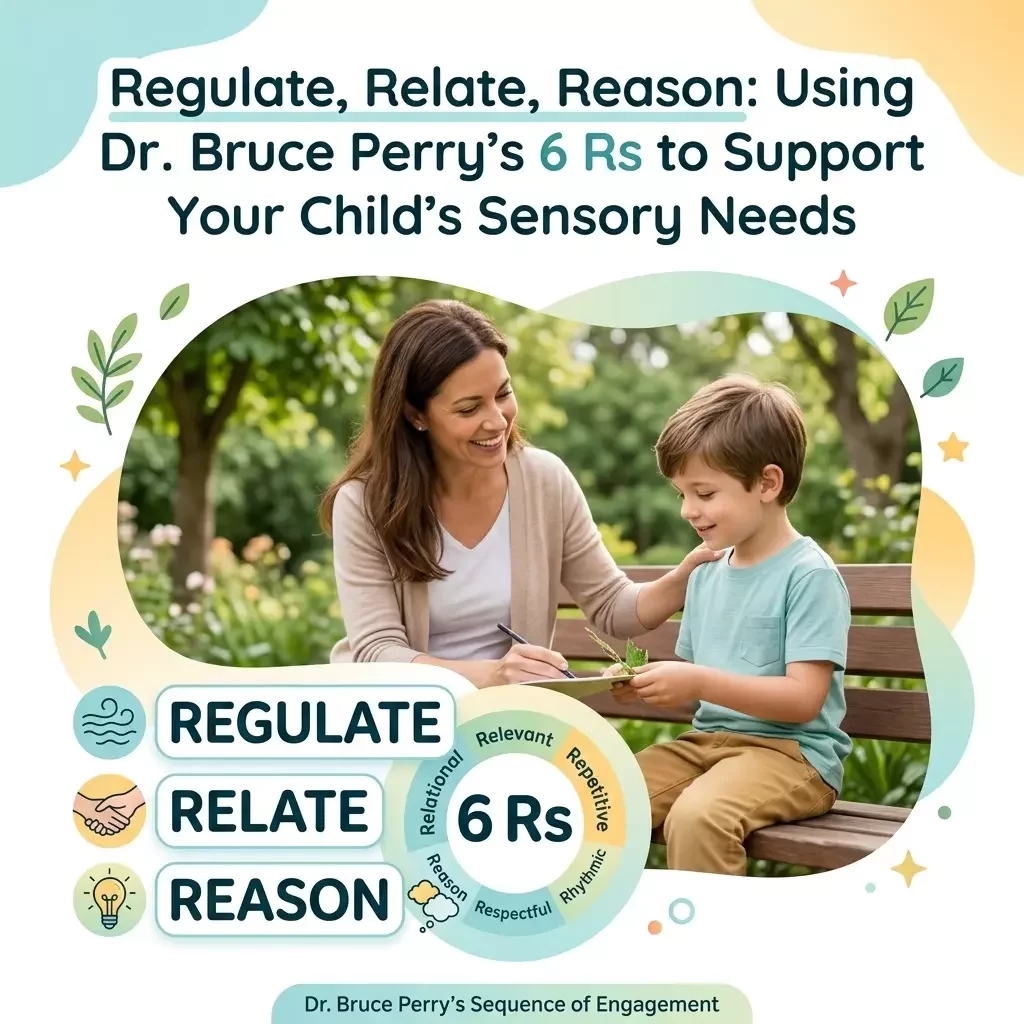
The Sequence of Engagement: Regulate, Relate, Reason
Before we dive into the 6 Rs, we have to understand the order of operations. Dr. Perry teaches us that the human brain processes information from the bottom up.
- Regulate: The brain stem (the bottom part) cares about safety and physical comfort. If a child is sensory-overloaded or scared, this part of the brain is "on fire."
- Relate: Once the brain stem is calm, we move to the limbic system. This is the emotional center where connection happens.
- Reason: Only after the bottom and middle parts of the brain are happy can we reach the cortex, the top part where logic, language, and "being reasonable" live.
Think of it like a ladder. You can’t get to the top step (Reasoning) if the bottom of the ladder is shaking. If your child is dysregulated, talking to them is like trying to give directions to someone in the middle of a hurricane. They can’t hear you! We have to stop the storm first.
Using the 6 Rs to Build a Regulated Life
Dr. Perry developed the "6 Rs" as a way to create "brain-friendly" environments. These are especially powerful for neurodivergent kids who might have sensory needs that keep their internal "alarm system" on high alert.
Let’s break them down in a way that feels manageable for your daily life.
1. Relational (Safe Adult Connection)
Everything starts with relationship. For a child to feel safe enough to regulate, they need to be in the presence of a "regulated" adult. This is the hardest part for us as parents! When our kids are screaming, our own "alarm system" goes off.
Relational means the interaction is safe, predictable, and nurturing. It’s about being "with" your child in their mess rather than just trying to "fix" the mess. Sometimes, just sitting quietly on the floor near them is the most powerful advocacy tool you have.
2. Relevant (Developmentally Matched)
We often expect our kids to act their "chronological age," but when a child is stressed or has developmental delays, their "emotional age" might be much younger.
If your 10-year-old is having a 3-year-old sized meltdown, we need to respond to the 3-year-old. Pushing them to "act their age" only adds more stress to an already overloaded brain. Relevant means matching our expectations and activities to where the child is right now, not where the calendar says they should be.
3&4. Repetitive and Rewarding (The Power of Pattern and Pleasure)
Dr. Perry emphasizes that the brain changes through repetition. However, for a child to want to keep trying, the activity also has to feel good. This is why we combine these two.
Think about a "sensory diet" or a daily routine. If we do the same calming activities every day, like a heavy-work chore or a specific swing, the brain starts to recognize the pattern and says, "Oh, I know this. I am safe here."
But it has to be Rewarding. If we force a child to do a "calming" exercise they hate, it’s no longer regulating; it’s stressful! Finding things your child naturally loves, whether it's Legos, jumping on a trampoline, or listening to a favorite song, and doing them over and over builds those neural pathways for peace. It turns "work" into "connection."

5. Rhythmic (Resonant with Neural Patterns)
Rhythm is the language of the brain stem. Think about how we soothe babies by rocking them or patting them on the back. That rhythmic movement tells the brain, "All is well."
For older kids, rhythm can look like:
- Walking or hiking
- Drumming
- Dancing to a steady beat
- Swinging
- Even rhythmic breathing (though "take a deep breath" can sometimes backfire if they aren't ready!)
When you notice your child starting to spiral, try moving with them. A rhythmic walk around the block can do more for regulation than an hour of "talking it out."
6. Respectful (Honoring the Individual)
This R is all about dignity. It’s respecting your child’s unique sensory profile, their family culture, and their autonomy. It means not forcing eye contact if it’s painful for them, or not forcing them to "hug grandma" if their sensory system is screaming "no."
When we respect their boundaries, we build the trust necessary for the "Relational" piece to work. It’s about saying, "I see you, I hear you, and I’m on your team."
Bringing the 6 Rs into the IEP Room
I know what you're thinking: "Lisa, this sounds great at home, but how do I get the school to do this?"
This is where special education advocacy comes in. You can actually build the 6 Rs and the "Regulate, Relate, Reason" framework into your child’s IEP or 504 plan.
Instead of just asking for "sensory breaks," we can advocate for "rhythmic, repetitive sensory activities scheduled throughout the day." We can ask for accommodations that prioritize regulation before any disciplinary conversation (Reasoning) takes place. We can asks for goals that teach kids to use these tools to promote regulation.
If a teacher understands that they need to Relate before they Reason, it changes the entire dynamic of the classroom. It moves the focus from "compliance" to "connection."
Taking the Burden Off Your Shoulders
If you are reading this and feeling overwhelmed: wondering how on earth you’re supposed to be a parent, a therapist, and a rhythmic-movement expert all at once: take a deep breath.
You don’t have to do this alone.
The goal isn't for you to be perfect; it's for you to have a roadmap. Sometimes, the most "Relational" thing you can do for your child is to take a break yourself. A dysregulated parent cannot regulate a dysregulated child.
At Advocating 4 Fair Education, our job is to help carry the heavy lifting of the paperwork and the school meetings so you can focus on being that "Safe Adult" your child needs. We collaborate with you to ensure the school sees your child's behavior through this lens of regulation, not "naughtiness."
Final Thoughts
Dr. Perry’s 6 Rs aren't just a "behavior plan": they are a way of looking at our children with compassion and science. By focusing on rhythm, repetition, and relationship, we aren't just stopping a meltdown; we are literally helping our children's brains grow and heal.
If you’re struggling to get your child’s school to understand these needs, or if you just need a friendly ally to help navigate the IEP process, reach out. We’re in this together.
Stay regulated, stay connected, and remember: you’re doing a great job.
References & Resources
- The Boy Who Was Raised as a Dog by Dr. Bruce Perry
- The Neurosequential Model Network (NMN)
© 2026 Advocating 4 Fair Education
- The Boy Who Was Raised as a Dog by Dr. Bruce Perry
- The Neurosequential Model Network (NMN)
© 2026 Advocating 4 Fair Education
Contact information
Get in touch with us

Want to bring Dr. Perry’s 6 Rs out of your living room and directly into your child’s classroom?
We're here to help!
Contact us for expert advocacy support. Our team is ready to assist you with your special education needs and concerns.
Support
support@advocating4faireducation.com